← Back to All Blogs
Manufacturing Strategy · 6 min read · Updated Sep 8, 2026
Assemble to Order (ATO): How It Works and When to Use It

TL;DR: Assemble to order (ATO) means keeping standard components in stock and only building the final product once a customer’s order confirms the exact configuration. It sits between make-to-stock and make-to-order, cutting finished-goods risk while still shipping variants fast.
This guide covers how ATO actually works on the shop floor, where it fits against make-to-stock and make-to-order, and how TranZact ties component stock to a bill of materials so assembly starts the moment an order is confirmed, not a week later.
What Is Assemble to Order (ATO)?
Assemble to order is a manufacturing strategy where a business pre-builds and stocks standard sub-assemblies or components, then finishes the specific configuration a customer ordered only after that order is confirmed.
It works because the variation usually lives in a handful of late-stage choices, memory, colour, add-on modules, not in every part of the product. Everything upstream of that choice point can be built to a forecast; everything downstream waits for the order.
Industries that run configurable products at volume, computers, industrial machinery, furniture, control panels, use ATO because full make-to-order is too slow and full make-to-stock means guessing which exact combination a customer wants.
How ATO Compares to the Alternatives
ATO at a Glance
Flexibility: the same stocked components can be finished into multiple configurations without separate purchase orders for each variant.
Lower finished-goods risk: nothing is fully built until an order exists, so there is no guessing which configuration will sell.
Faster than make-to-order: sub-assemblies are already on the shelf, so final assembly is hours, not weeks.
Space efficiency: storing components takes less room than storing every possible finished configuration.
Still needs accurate BOM and component stock data: ATO breaks down fast if the bill of materials or component counts are wrong.
Aspect
Make-to-Stock
Assemble-to-Order
Production trigger
Sales forecast
Confirmed customer order
Finished-goods stock held
High, full units pre-built
Low, only components held
Lead time to ship a variant
Immediate, if the variant guessed correctly
Hours to days, assembled on demand
Customisation possible
None after production
Configuration chosen at order time
Risk when demand shifts
Obsolete finished stock
Component stock still usable across configurations
Where TranZact fits
Not applicable
Ties component stock to BOM so assembly starts the moment an order confirms
The ATO Process, Step by Step
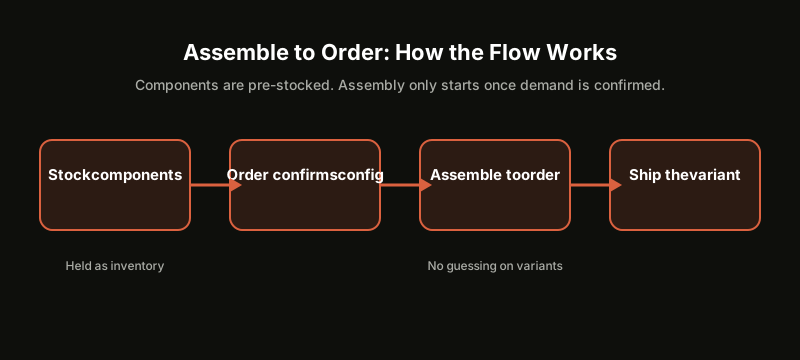
A working ATO setup has four stages, and skipping the stock-accuracy step upstream is where most factories break it:
Stock standard components. Sub-assemblies and common parts are built or bought against a forecast and held as inventory, not as finished units.
Order confirms the configuration. The customer picks the exact combination, memory, finish, capacity, at the point of sale, locking the bill of materials for that unit.
Pull and assemble. Stores issues the required components against that BOM, and the final assembly step only starts once the configuration is locked.
Ship the specific unit. Because assembly is short, the order-to-ship window stays close to make-to-stock speed even though the product was never pre-built.
Where ATO Breaks Down in Practice
ATO looks simple on paper. In practice these five issues show up across manufacturers who adopt it without fixing their data first:
Inaccurate BOMs. If the bill of materials for a configuration is wrong or outdated, assembly stalls mid-order while stores hunts for the right part.
Component stock nobody trusts. ATO only works if component counts are accurate in real time; a stock count that is off by a few units turns into a missed ship date.
No link between sales and BOM. When the order desk and the shop floor use separate systems, configuration details get re-keyed and errors creep in.
Complex coordination across vendors. Multiple component vendors for the same configuration means one late delivery can hold up every order that needs it.
Costs creep up. Carrying a wide range of components for every possible configuration is cheaper than carrying finished goods, but it is not free: slow-moving components still tie up cash.
Not sure your component stock is accurate enough to run ATO safely?
TranZact ties every configuration’s BOM to real-time component stock, so assembly only starts once the parts are actually on the shelf, not on a spreadsheet that was updated last week.
Check your component stock accuracy →
How TranZact Helps With Assemble to Order
TranZact ties your bill of materials to live component stock, and matches that against production scheduling, so the moment an order confirms a configuration, the system already knows what is on hand and what still needs a purchase order.
None of this needs a separate ATO module. It just means sales, inventory and production are reading the same bill of materials and the same stock numbers instead of three different spreadsheets.
FAQs
What is the difference between assemble to order and make to order?
Make-to-order starts every step from raw material after the order arrives, so lead times are longer. Assemble-to-order pre-stocks components and only finishes assembly after the order, so it ships faster while still allowing configuration.
What is the difference between assemble to order and make to stock?
Make-to-stock builds full finished units against a forecast, so it ships instantly but risks holding the wrong configuration. Assemble-to-order holds components instead of finished units and configures at order time, trading a short assembly wait for far less obsolete stock.
Which industries use assemble to order?
Computer hardware, industrial machinery, furniture, control panels and any product with a manageable number of late-stage configuration choices, memory, colour, capacity, add-on modules, typically run ATO.
What data does ATO actually depend on?
Accurate bills of materials for every configuration and real-time component stock counts. ATO does not require exotic software, it requires those two numbers to be trustworthy at the moment an order is confirmed.
Can a small manufacturer run ATO on spreadsheets?
It is possible at very low volume, but BOM and stock accuracy degrade fast once more than one person is updating the sheet. Most manufacturers that scale past a handful of configurations move component stock and BOM data into a shared system.
Related Reading
Check out other blogs



Born in India. Building for the world.
Built by IIT & IIM founders