← Back to All Blogs
Inventory Management · 6 min read · Updated Sep 8, 2026
Inventory Records: Manual vs Software-Driven Tracking for Manufacturers

TL;DR: Inventory records are the structured data trail, item ID, quantity on hand, location, reorder point, lead time, that a manufacturer keeps for every SKU. Manual registers capture this after the fact; software-driven records capture it the moment stock moves, in real time, across every warehouse.
This guide covers what a complete inventory record actually contains, why manual registers fall behind the moment more than one person touches stock, and how TranZact keeps every warehouse’s records current the instant stock moves, not at month-end reconciliation.
What Are Inventory Records?
An inventory record is the data behind every SKU: item or part number, description, unit of measure, quantity on hand, reorder point, lead time, cost, and physical location. Together these fields tell you exactly what you have, where it is, and when to reorder it.
Getting this right matters because inventory is usually the largest working-capital line on a manufacturer’s balance sheet. Records that lag reality by a day, a shift, or a stack of unfiled paper slips translate directly into stockouts, overstock, and cash tied up in the wrong SKUs.
Every manufacturer needs inventory records, whether they run a single store or ten warehouses across states. The method changes with scale: a small job shop can survive on a register for a while, a multi-location manufacturer with GST filings and audit trails cannot.
Manual Registers vs Software-Driven Records
Inventory Records at a Glance
Fewer stockouts. Up-to-date records let you fill customer orders on time instead of discovering a shortage at the point of dispatch.
Smarter restocking decisions. Accurate quantity-on-hand and reorder-point data tell you what to buy and when, instead of guessing.
Audit-ready by default. A timestamped digital trail supports GST reconciliation and financial audits without a month-end scramble.
Accurate costing. Real-time records show the true cost of goods sold instead of a stale month-old number.
Less paperwork, fewer errors. One system of record replaces registers, spreadsheets, and the reconciliation between them.
Aspect
Manual / Register-Based Records
Software-Driven Inventory Records
Update timing
End of shift or day, backdated by hand
Logged the moment stock moves, in real time
Multi-location visibility
Separate register per store, no combined view
One dashboard across every warehouse
Error rate
High, manual entry and double counting
Low, entries log themselves as stock moves
Reorder point tracking
Manual calculation, often missed
Automatic alerts before stock runs out
Audit trail
Paper trail, easy to lose or backdate
Timestamped digital log, always reconstructable
Where TranZact fits
Not applicable
Logs every stock movement instantly across warehouses, with batch tracking and ageing history
How to Keep Accurate Inventory Records
Whatever method you use, four practices keep inventory records trustworthy, and skipping the first one is where most manual systems quietly fall apart:
Pick one valuation method and stick to it. FIFO, LIFO, or weighted average, consistency across accounting periods is what makes the numbers usable for reporting and tax filing.
Cross-check counts against transactions. Compare what physically came in and went out against what the record shows, so errors get caught within days, not at year-end stocktake.
Train whoever touches the record. Inconsistent data entry from different staff is the single biggest cause of records that quietly drift from reality.
Update the record the moment stock moves. A record updated at end of shift is already hours out of date; barcode or system-driven entry closes that gap to zero.
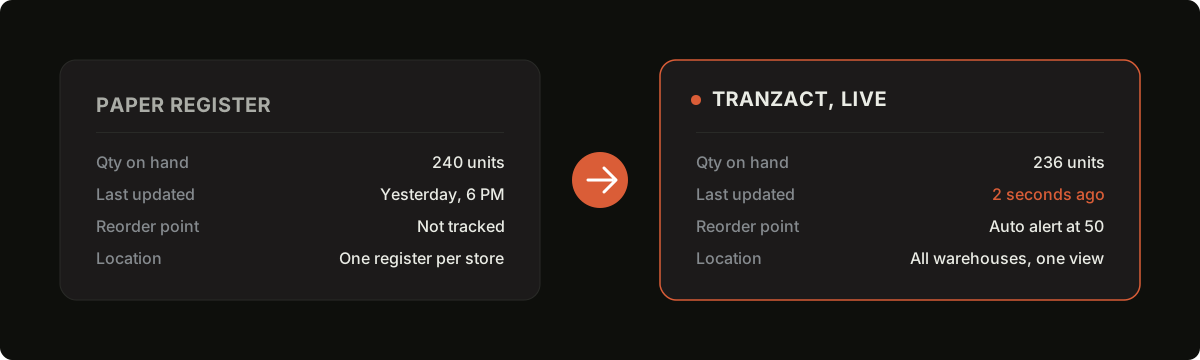
What Goes Wrong With Manual Inventory Records
Manual records look fine until stock volume grows past what one person can track by hand. Five failure patterns show up again and again:
No visibility into demand shifts. Static records don’t reflect what’s actually selling, so restocking decisions lag reality by days or weeks.
Order quantity mistakes. When the record doesn’t match physical stock, purchasing either over-orders or gets caught short.
Weak forecasting. Without a live view of stock movement, demand planning is a guess dressed up as a plan.
Theft and shrinkage go unnoticed. A record nobody reconciles in real time can’t catch a shortage until the next physical count, sometimes months later.
Compliance risk at filing time. Reconciling a quarter’s worth of paper entries against GST returns turns a routine filing into a scramble.
Not sure your paper stock count matches what’s actually on the shelf?
TranZact logs every stock movement the moment it happens, across every warehouse, so your inventory record is never more than a few seconds behind the shop floor.
See your real-time stock records →
How TranZact Keeps Inventory Records Live
TranZact logs every stock movement, in, out, and transfer, the moment it happens, across every warehouse, and keeps automatic reorder point alerts plus a running ageing and valuation history for every SKU.
None of this needs a separate inventory records module. It just means your quantity on hand, reorder points, and stock value are always current, with one-way sync to Tally so your accounting stays untouched while inventory records stay live.
FAQs
How often should you do a physical inventory count?
Quarterly at minimum for most manufacturers, more often for fast-moving or high-value SKUs. Businesses running live, software-driven records can supplement quarterly counts with rolling cycle counts instead of shutting the floor down once a year.
Can inventory records be corrected for damaged or lost stock?
Yes. Damaged, lost, or written-off stock gets corrected through an inventory adjustment entry, which should carry its own audit trail rather than a silent edit to the original count.
Are inventory records required for GST and financial audits?
Yes. Accurate, timestamped inventory records are the backbone of GST reconciliation and financial audits, they are the trail auditors ask for first.
How do inventory records connect to accounting software?
Through a sync, not a rebuild. TranZact keeps a one-way sync to Tally, so your accounting books stay exactly as your accountant expects while inventory records update live inside TranZact.
What is the difference between an inventory record and a stock report?
An inventory record is the live data for a single SKU: quantity, location, reorder point. A stock report is a snapshot pulled from many records at a point in time, useful for review, but only as accurate as the records feeding it.
Related Reading
Check out other blogs

MRP Software Guide
6 min read
Complete buying guide to MRP software for manufacturers.
Read More

Stock Reconciliation Guide
5 min read
Keep system and physical component stock in sync.
Read More

Best Inventory Management Software for Manufacturers
7 min read
Compare top inventory management tools built for Indian SME manufacturers.
Read More

Born in India. Building for the world.
Built by IIT & IIM founders