← Back to All Blogs
Inventory Management · 6 min read · Updated Sep 2026
Stock Balance: How to Calculate and Verify It Correctly

Stock balance is the quantity of an item you should have on hand right now: opening stock plus everything received, minus everything issued or sold. It only means something when it matches the physical count on the shelf, a stock balance that looks right on paper but is wrong in the warehouse is worse than no record at all.
Manufacturers usually find out their stock balance is wrong at the worst possible moment: mid-production, or during a customer order. This guide covers how to calculate stock balance correctly, verify it against a physical count, and fix the most common causes when the two do not match.
What Is Stock Balance?
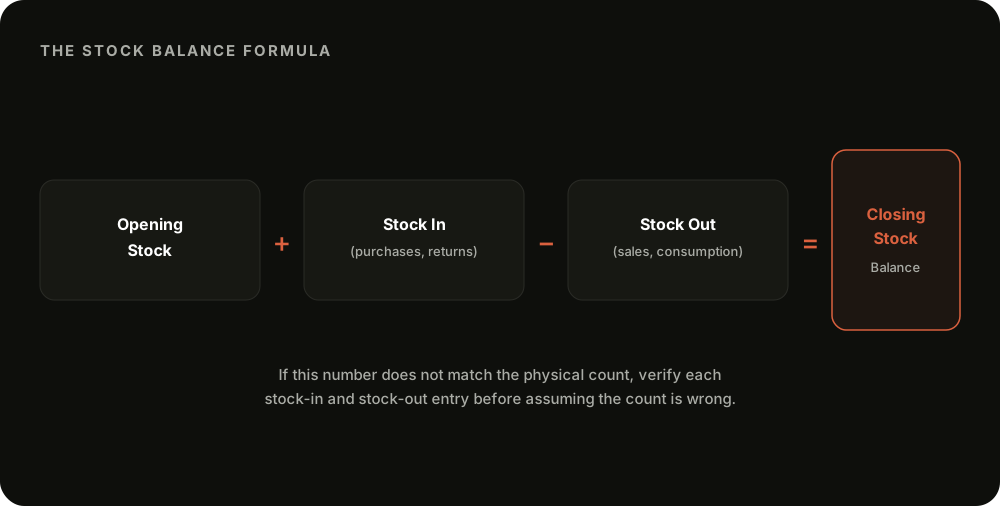
Stock balance is the running total of how much of an item is currently available, calculated as opening stock plus stock received minus stock issued. Every inventory system, whether a paper register or software, is built around keeping this number accurate in real time.
It matters for two reasons: it tells you whether you can fulfill an order without checking the shelf first, and it is what your books use to value inventory on the balance sheet. Both purposes fail the moment stock balance drifts from reality.
For most Indian SME manufacturers, stock balance goes wrong not because the formula is hard, it is one line of arithmetic, but because one of the three inputs, opening stock, stock in, or stock out, is recorded late, wrong, or not at all.
How to Calculate Stock Balance
The Stock Balance Calculation, Step by Step
Start with the last verified opening stock, from a physical count, not a system carry-forward you have not checked recently.
Add every stock-in transaction since then: purchases received, production output, and any stock transferred in from another location.
Subtract every stock-out transaction: sales, production consumption, and stock transferred out.
The result is your calculated stock balance. Compare it against a physical count of the same item.
If the two numbers do not match, the gap points to a missing or wrong entry somewhere in stock-in or stock-out, not necessarily a theft or loss.
Cause
What It Looks Like
How to Catch It
Unrecorded stock movement
Goods moved between locations without a matching entry
Reconcile transfer logs against warehouse counts weekly
Manual entry errors
Wrong quantity or wrong item typed into the register or spreadsheet
Cross-check high-value SKUs during cycle counts
Timing mismatch
A sale or GRN recorded a day after the physical movement happened
Record stock movements the same day they occur
Damaged or expired stock not written off
Physically unusable stock still counted as available
Run a scrap and write-off review every month
Duplicate or missing GRNs
A purchase received twice on paper, or never entered at all
Match GRN count against supplier invoice count
Shared logins or informal handovers
Multiple people updating the same register without a clear owner
Assign one person per location as the stock record owner
Common Signs Your Stock Balance Is Wrong
A few recurring symptoms show up before a full physical count confirms the mismatch.
A physical count that never quite matches the system. Small, recurring gaps on the same few SKUs usually point to a process issue, not a one-off mistake.
Stock showing available that the shop floor cannot find. Often traces back to a transfer or consumption entry that was never recorded.
Negative stock appearing in the system. A mathematically impossible balance means a stock-out was recorded before its matching stock-in.
Reorder alerts firing at the wrong time. If reorder points fire too early or too late, the stock balance driving them is probably already off.
How to Keep Stock Balance Accurate
A few habits prevent most stock balance problems before they need a full physical recount to catch.
Record stock movements the same day they happen. A goods receipt or issue entered a week late is a week of wrong stock balance for every other calculation that depends on it.
Run cycle counts on high-value or fast-moving SKUs monthly. Waiting for an annual physical count means a full year of undetected drift.
Assign one owner per stock location. Shared logins and informal handovers make it impossible to trace where an entry went missing.
Write off damaged or obsolete stock promptly. Unusable stock sitting in the system as available inflates the balance and the inventory valuation with it.
Treat a mismatch as a process signal, not just a number to correct. Adjusting the balance without finding the cause guarantees the same gap reappears next month.
Still finding out your stock balance is wrong only when a physical count catches it?
TranZact logs every stock movement the moment it happens, so your stock balance stays accurate between counts instead of drifting silently.
See Real-Time Stock Balance in TranZact →
Where TranZact Fits for Stock Balance
TranZact logs every stock movement automatically across every warehouse, so the calculated balance matches the physical count without someone reconciling a spreadsheet at month end.
TranZact does not replace a physical count entirely, no software does. What it does is remove the most common cause of drift: a stock movement that never got recorded because someone forgot to update a register.
FAQ
What is the formula for stock balance?
Stock balance equals opening stock plus stock in, purchases, production, transfers in, minus stock out, sales, consumption, transfers out.
How often should stock balance be verified against a physical count?
Monthly for fast-moving or high-value items, quarterly for the rest, and immediately after any process change that touches how stock is recorded.
What usually causes a stock balance mismatch?
Unrecorded stock movements, manual entry errors, and timing gaps between when a movement happens and when it gets recorded are the most common causes.
Is a small stock balance mismatch normal?
Occasional small gaps happen even in well-run systems. A recurring gap on the same SKUs points to a process issue worth fixing, not just adjusting away.
Can stock balance be tracked without inventory software?
Yes, at a small scale, with a disciplined manual register. It gets harder to keep accurate as SKU count, order volume, or warehouse count grows.
Related Reading
Check out other blogs



Born in India. Building for the world.
Built by IIT & IIM founders