← Back to All Blogs
Production Planning · 8 min read · Updated September 2026
Production Planning System: Meaning, Objectives & Benefits

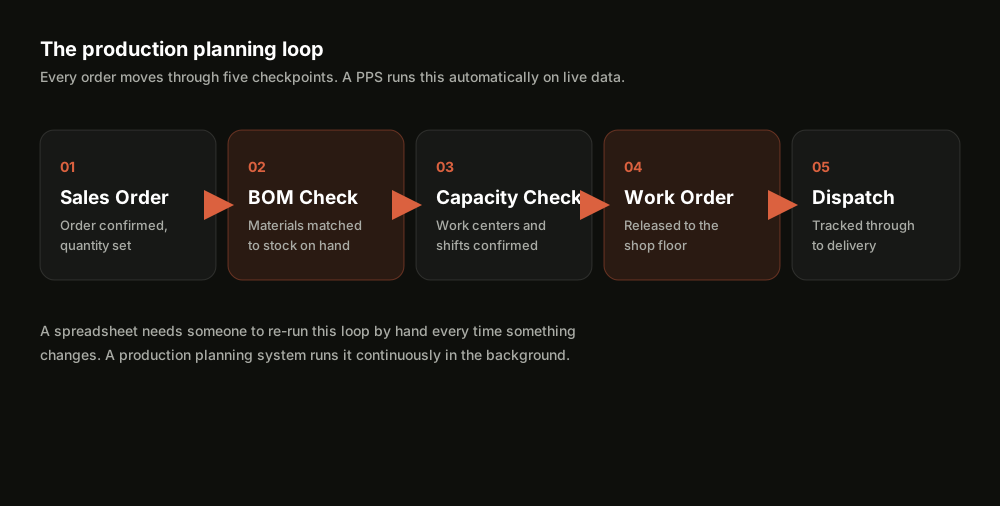
A production planning system is software that turns your sales orders and bill of materials into a realistic production schedule, checks material and capacity availability, and tracks each work order through to dispatch, replacing the spreadsheet-and-gut-feel planning most SME manufacturers start with.
Every manufacturer plans production somehow, whether that is a formal system or a supervisor’s notebook. The difference between the two shows up the first time an order changes, a machine breaks down, or a customer wants a firm delivery date.
What Is a Production Planning System?
A production planning system (PPS) is software that plans, schedules, and monitors your manufacturing process end to end, from converting a sales order into material requirements to releasing work orders and tracking them until the product ships.
It pulls from your bill of materials, current stock, and order backlog to tell production, purchase, and sales teams the same thing at the same time: what needs to be made, by when, and whether the factory can actually hit that date.
Most Indian SME manufacturers start with spreadsheets and a supervisor’s judgment, and that works until order volume or SKU complexity grows past what one person can track in their head.
Production Planning System vs Manual Scheduling
Production Planning at a Glance
Turns sales orders into a material and capacity plan automatically, instead of a manual re-check every time.
Pulls from live BOM and routing data, not a spreadsheet someone forgot to update.
Flags material shortages and overloaded work centers before the order is confirmed, not after.
Gives production, purchase, and sales the same view of what is actually scheduled.
Needs accurate BOM and stock data to work. Garbage in still means garbage out.
Aspect
Manual / Spreadsheet Planning
Production Planning System (PPS)
Data source
Planning basis
Gut-feel schedules and a spreadsheet rebuilt by hand
Granularity
Update frequency
Redone manually whenever something changes
Update frequency
Visibility
One planner’s file, rarely shared beyond them
Overload detection
Material planning
Manual reorder checks, frequent last-minute shortages
Tooling
Delay detection
Found on the shop floor, after it is already late
Where TranZact fits
Where TranZact fits
Multi-level BOM, work order tracking, real-time production visibility
Objectives and Functions of a Production Planning System
A production planning system runs through the same core functions on every order, whether it is built into dedicated software or run manually on a spreadsheet.
Set production targets from demand. Convert confirmed sales orders and forecasts into a realistic production quantity and sequence, balancing customer demand against actual capacity.
Plan material requirements against the BOM. Explode each order’s bill of materials against current stock to know exactly what raw material needs to be purchased and when.
Schedule capacity and sequence orders. Assign work to machines and shifts in an order that keeps lead times short and work centers from sitting idle or overloaded.
Release and monitor orders. Issue work orders to the floor and track progress against the plan so delays get caught and re-planned early, not at the delivery deadline.
Where Production Planning Breaks Down in Practice
Production planning fails in predictable ways when the underlying data is stale or nobody owns the plan after it is made.
BOM and routing data that is out of date. A plan built on a bill of materials nobody has updated in months will always under-order some component and over-order another.
The plan is made once, then forgotten. A confirmed order or a machine breakdown changes what is actually possible, but the schedule on the wall does not move with it.
No shared view across departments. Sales promises a delivery date without checking whether production or purchase can actually support it.
Material shortages caught too late. Without a live material check tied to the plan, a missing component surfaces on the shop floor instead of before the order is confirmed.
Manual tracking loses the thread mid-order. Once a job is released, a spreadsheet plan rarely gets updated with real progress, so nobody notices a delay until the ship date is at risk.
Still re-planning production on a spreadsheet every time an order changes?
TranZact gives you multi-level BOM and real-time work order tracking across the shop floor, so your production plan reflects what is actually on hand and in progress, not what a spreadsheet assumed last week.
See your production plan in TranZact →
Where TranZact Fits for Production Planning
TranZact is not a shift-by-shift finite capacity scheduler, what it gives you is multi-level BOM and real-time work order tracking across the shop floor, plus MRP-driven purchase planning tied to actual stock, so your production plan reflects what is really available.
That is not the same as a dedicated finite-capacity scheduling engine, and we would rather say that plainly than have you find out mid-rollout. For most SME manufacturers, tying production planning to a live BOM, real stock, and work order tracking closes the actual gap: planning against data that is already out of date by the time the shift starts.
FAQ
What is a production planning system?
A production planning system (PPS) is software that converts sales orders into a production schedule, checks material and capacity availability against the bill of materials, and tracks work orders from release to dispatch.
What is the difference between production planning and production control?
Production planning sets the schedule: what to make, how much, and by when. Production control monitors execution against that schedule and corrects course when actual output falls behind plan.
Do small manufacturers need dedicated production planning software?
Not always at low order volume. Once you are tracking more than a handful of SKUs or orders change frequently, a spreadsheet stops catching material and capacity conflicts before they hit the shop floor, and that is usually the point to move to dedicated software.
What data does a production planning system need?
A bill of materials for each product, routing or process data, current stock levels, and the confirmed order backlog. A plan is only as accurate as the least up-to-date of these inputs.
How much does a production planning system cost for an Indian SME?
Pricing varies with your production complexity, order volume, and team size. Most SME-focused platforms price per user per month rather than as a flat licence fee, so it is worth getting a quote scoped to your actual operation rather than a published starting price.
Related Reading
Check out other blogs

Capacity Requirements Planning (CRP): How It Works in Manufacturing
9 min read
What Capacity Requirements Planning is, how it compares to manual capacity planning, and how to check whether your factory can actually hit its production schedule.
Read More

Just-In-Time (JIT) Manufacturing: Meaning, Benefits & Risks
8 min read
What Just-In-Time manufacturing is, how it cuts holding costs, and why Indian manufacturers need demand-driven buying to make it work.
Read More

Batch Production vs Mass Production: Key Differences
7 min read
A side by side comparison of batch and mass production, and how to choose for your factory.
Read More

Born in India. Building for the world.
Built by IIT & IIM founders