TL;DR: A delivery note is a document that accompanies a shipment listing what was sent, quantity, description, and dispatch details, so the buyer can confirm what arrived against what was ordered. It is not a tax document and creates no GST liability on its own; that role belongs to a delivery challan or tax invoice.
This guide covers what a delivery note should contain, how it differs from a delivery challan and a tax invoice, and where it fits in the dispatch-to-invoice sequence for a manufacturer.
What Is a Delivery Note?
A delivery note, also called a dispatch note, is a document that accompanies a shipment listing what was sent, the quantity, description and destination, so the buyer can check what arrived against what was actually dispatched.
It is not a tax document. A delivery note by itself does not create a GST liability or serve as proof of supply for tax purposes, that role belongs to a proper tax invoice or delivery challan issued under GST rules.
In Indian manufacturing the term is often used loosely alongside delivery challan, the two overlap in purpose but a delivery challan has specific GST format requirements a plain delivery note does not.
Delivery Note vs Delivery Challan
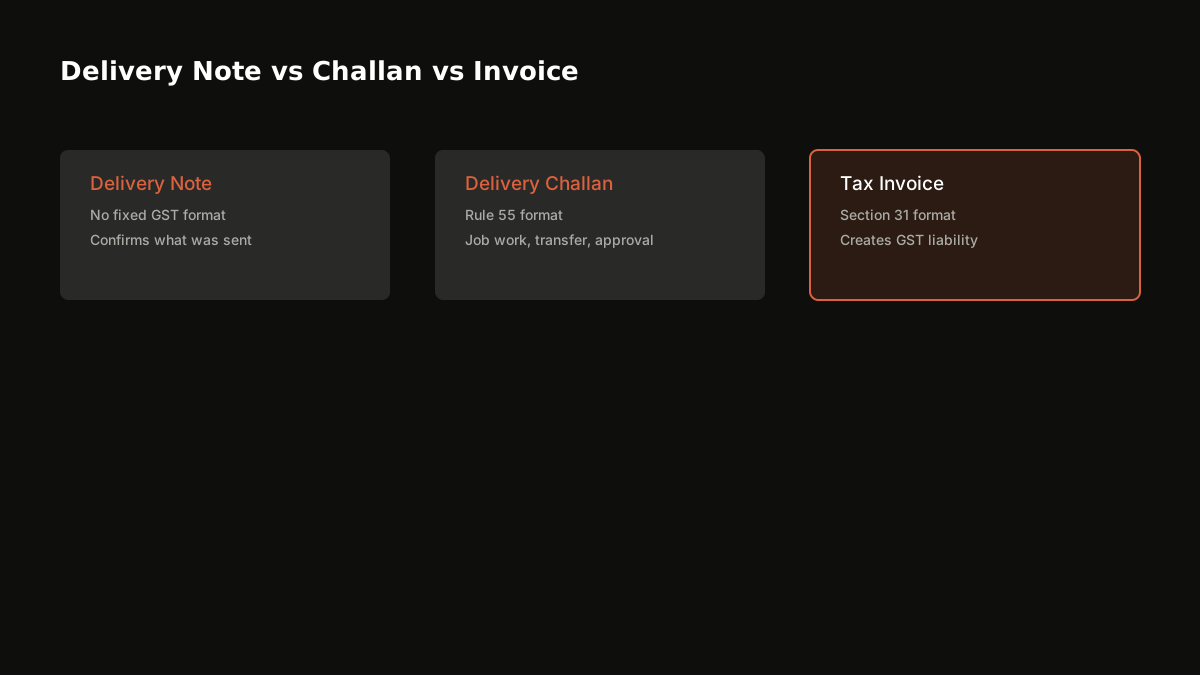
Delivery Note vs Delivery Challan vs Tax Invoice
Purpose: a delivery note confirms what was physically sent; a delivery challan is a GST-compliant document for goods movement without immediate sale; a tax invoice is the legal GST document for a completed sale.
GST format requirements: a delivery note has no fixed GST format; a delivery challan must meet Rule 55 requirements; a tax invoice must meet Section 31 requirements.
Tax liability: neither a delivery note nor a challan by itself creates GST liability; a tax invoice does.
When each is used: delivery notes are informal and optional; challans are used for job work, stock transfer or approval-basis movement; invoices are used for a completed sale.
Manufacturer relevance: for anything moving under GST that is not a straightforward sale, a proper delivery challan matters more than an informal delivery note.
What a Delivery Note Should Contain
A usable delivery note covers four things at minimum:
Buyer and seller details. Names and addresses of both parties, so the shipment is clearly tied to a specific order.
Item description and quantity. What was sent and how much, matched against the order or purchase order it fulfills.
Dispatch date and reference. When the goods left, and a reference back to the order, invoice or challan it relates to.
Signatures or acknowledgment. Space for the buyer to confirm receipt, since that confirmation is often the only proof a shipment actually arrived intact.
Where Delivery Notes Go Wrong
The same issues show up repeatedly:
Treating a delivery note as a substitute for a GST delivery challan. A plain delivery note does not meet Rule 55 requirements, if goods are moving under GST, a proper delivery challan is usually what is actually needed.
No reference back to the order. Without a PO or order number on the note, matching what arrived against what was ordered becomes a manual reconciliation exercise.
Quantity mismatches never followed up. A delivery note showing a different quantity than what was ordered gets filed without anyone flagging the discrepancy.
Manual, paper-based notes with no digital record. When the only copy is a physical slip, there is no searchable trail if a dispute comes up later.
Confusing delivery note, challan and invoice. All three serve different purposes, treating them interchangeably causes GST compliance gaps.
Do your dispatch records actually tie back to the order and invoice they belong to, or does that need a manual paper trail search?
TranZact’s Dispatch and GST e-invoicing flow ties every shipment to its order and invoice automatically, so there is a digital record instead of a loose paper delivery note nobody can trace back.
See Dispatch Records Tied to GST →
How TranZact Handles Delivery Documentation
TranZact runs Dispatch through GST e-invoicing as one connected flow, so every shipment ties back to its order and the correct GST document gets generated automatically, instead of a loose delivery note with no link to the paperwork behind it.
It does not replace your accountant’s judgment on which GST document a specific movement needs, delivery challan versus tax invoice. What it fixes is making sure whichever document applies is actually tied to a real order, not filled in by hand.
FAQs
What is a delivery note?
A delivery note is a document accompanying a shipment that lists what was sent, quantity, description and destination, so the buyer can confirm what arrived against what was dispatched. It is not a GST tax document on its own.
What is the difference between a delivery note and a delivery challan?
A delivery challan has specific GST format requirements under Rule 55 and is used for goods movement without an immediate sale, job work, stock transfer, approval basis. A delivery note is a more informal document with no fixed GST format.
Is a delivery note required under GST?
Not specifically. What GST requires, depending on the transaction, is either a tax invoice for a sale or a delivery challan for other goods movement. A delivery note can be used alongside these but does not replace either.
Can a delivery note be used instead of an invoice?
No. A delivery note does not create GST liability or serve as a valid tax document. A proper tax invoice or e-invoice is required for an actual sale.
What should a delivery note include?
Buyer and seller details, item description and quantity, dispatch date, a reference back to the order it fulfills, and space for the buyer to acknowledge receipt.
Related Reading
Check out other blogs




Born in India. Building for the world.
Built by IIT & IIM founders