← Back to All Blogs
ERP Software · 7 min read · Updated Sep 2026
Key ERP Features You Need to Know (2025 Guide for Indian SMEs)

TL;DR: The ERP features that actually matter for an Indian manufacturing SME are tied to production, not generic office automation: warehouse-wise stock tracking, multi-level BOM, work order tracking, MRP-driven purchase planning, batch tracking, GST e-invoicing, and Tally sync. Everything else is a nice-to-have.
This guide breaks down the ERP features that move the needle for manufacturing SMEs, what each one actually solves, and who genuinely needs it, so you are not paying for a feature list built for a trading company or a services business.
What ERP Features Actually Means for a Factory
An ERP replaces separate spreadsheets, WhatsApp groups, and disconnected software for inventory, production, purchase, and sales with one system. The word features gets used loosely: some vendors count every checkbox on a spec sheet, others count only what a factory actually opens every day.
Most ERP vendors sell on feature count. The better filter is fit: does the feature reflect how a factory actually runs, with raw material consumption, work orders, and multi-warehouse stock, or is it a generic accounting or CRM feature repackaged as ERP.
A trading business and a manufacturing SME need different features entirely. A trader needs purchase and sales tracking. A manufacturer needs production planning, BOM, and batch tracking layered on top of that, or the ERP is really just inventory software with an invoice generator.
The 7 ERP Features That Actually Move the Needle
Quick Take Before the Full Breakdown
Production features beat office features. Warehouse tracking, BOM, and work orders solve real factory problems; generic CRM or HR modules rarely get used.
Compliance features are not optional. GST e-invoicing has to be correct on day one, not a phase-two add-on.
Sync matters more than replacement. A one-way sync to Tally or Zoho beats forcing your accountant onto a new system.
Traceability protects you later. Batch tracking only pays off when there is a quality issue or recall, by which point it is too late to add it.
Planning features prevent firefighting. MRP-driven purchasing means buying based on actual demand, not a gut-feel reorder.
Feature
What It Solves
Who Needs It
Warehouse-wise real-time stock tracking
Know exact stock by location instantly, instead of a manual count or a WhatsApp update from the warehouse
Manufacturers running more than one warehouse or store
Multi-level BOM
Plan raw material and sub-assembly needs accurately for products with multiple stages, not just a flat parts list
Manufacturers assembling finished goods from sub-components
Work order tracking
Shows what is being made, on which line, and by when, instead of relying on a supervisors memory
Job-shop and made-to-order manufacturers
MRP-driven purchase planning
Buys exactly what is needed based on actual demand and lead time, not a fixed reorder point
Businesses with long lead-time or imported raw materials
Batch tracking
Traces every unit back to its raw material batch, critical for a quality issue or recall
Regulated or quality-sensitive manufacturing
GST e-invoicing
Generates compliant invoices automatically, without manual entry into a separate portal
Every GST-registered manufacturer
One-way Tally or Zoho sync
Eliminates re-entering the same sales and purchase data into your accounting software
Businesses already using Tally or Zoho for accounting
How to Prioritise These 7 Features for Your Factory
Not all 7 features matter equally for every manufacturer. A few signals point to what to weigh heaviest:
How many warehouses or stores you run. More locations make warehouse-wise tracking and reorder alerts non-negotiable, not a nice-to-have.
How complex your BOM is. Multiple raw materials or sub-assemblies per product make multi-level BOM and work order tracking matter more than any other single feature.
How tight your cash flow is. Thinner margins make MRP-driven purchase planning pay for itself faster than a long feature list ever will.
Whether you already use Tally or Zoho. An existing accounting setup makes one-way sync a priority over trying to replace it.
Where ERP Feature Lists Go Wrong
The wrong feature set shows up in predictable ways once the ERP is actually in use on the shop floor.
Counting features instead of checking fit. A long feature list sold in a demo often includes accounting, HR, and CRM modules a factory will never open, while missing BOM or batch tracking entirely.
No manufacturing-specific tracking. Generic ERP software cannot tie raw material consumption to a work order, so inventory just means a static count, not a live picture.
Treating compliance as an afterthought. GST e-invoicing bolted on later, instead of built in, means manual correction every filing cycle.
Forcing a switch instead of syncing. Replacing an accountants Tally setup outright causes more resistance than a clean one-way sync ever would.
Skipping the adoption test. A feature that looks complete in a demo gets ignored on the floor if operators cannot use it without training.
Paying for ERP features your factory never opens, while still missing warehouse-wise stock tracking or BOM?
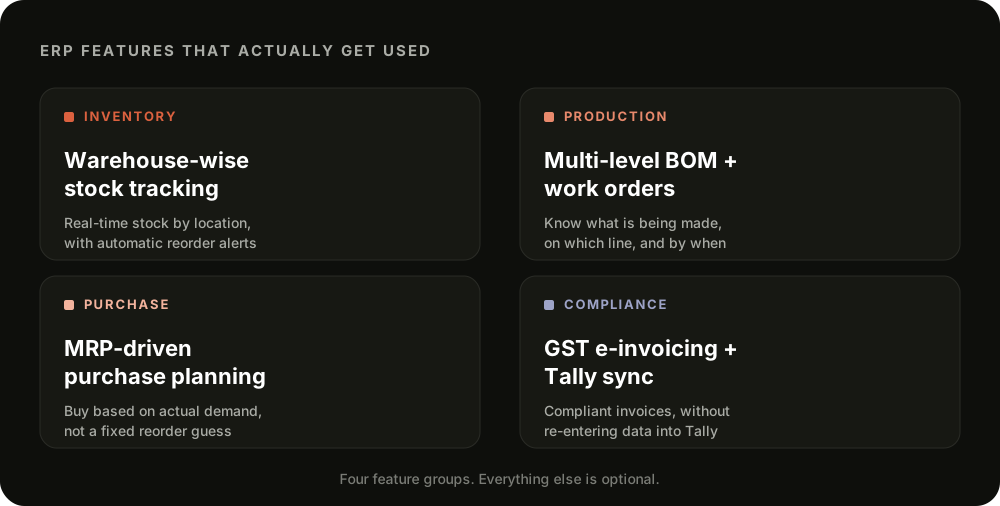
TranZact covers the production-first features that matter: warehouse-wise stock, work orders, MRP-driven purchasing, and GST e-invoicing, all built in, not bolted on.
See the Features Built for Factories →
Which ERP Features TranZact Actually Has
TranZact tracks warehouse-wise stock with automatic reorder alerts and covers multi-level BOM, work orders, and MRP-driven purchase planning, plus GST e-invoicing and a one-way sync to Tally or Zoho. If you are comparing full ERP options, see TranZact vs ERPNext.
If you need multi-entity accounting, deep CRM, or complex HR workflows, a broader ERP like Odoo or ERPNext might fit better. TranZact is built specifically for the production and inventory side of a manufacturing SME, not as a general-purpose business suite, and we would rather say so upfront.
FAQ
What are the core features of an ERP for a manufacturer?
Warehouse-wise stock tracking, multi-level BOM, work order tracking, and MRP-driven purchase planning are the features that get used daily. Generic CRM, HR, or advanced accounting modules matter far less for a factory.
What is the most important ERP feature for a small manufacturer?
Manufacturing-specific fit. Generic trading or accounting-first software can track stock quantities but cannot tie material consumption to a work order or a bill of materials, which is what actually drives inventory accuracy.
Does an ERP need dedicated GST compliance features?
Yes. A manufacturing-first ERP should generate GST-compliant e-invoices automatically as part of the sales flow, not require a separate compliance tool bolted on later.
Can an ERP replace Tally for a manufacturing SME?
Not for accounting. The better pattern is a production-focused ERP that syncs one-way into Tally, so the accountant keeps their system of record while the factory gets manufacturing-specific tracking.
How many ERP features does a small manufacturer actually need?
Fewer than most vendors sell. Warehouse tracking, BOM, work orders, MRP-driven purchasing, batch tracking, and GST e-invoicing cover what gets used daily, the rest is often unused.
Related Reading
Check out other blogs

Production Mgmt Software
7 min read
Features and buying guide for production management software.
Read More

TranZact vs Marg ERP
5 min read
See how TranZact compares to Marg ERP for Indian manufacturers.
Read More

Production Planning Types
6 min read
The different types of production planning explained.
Read More

Born in India. Building for the world.
Built by IIT & IIM founders