← Back to All Blogs
Manufacturing Methods · 7 min read · Updated Sep 9, 2026
Intermittent Production: Definition, Methods & Examples

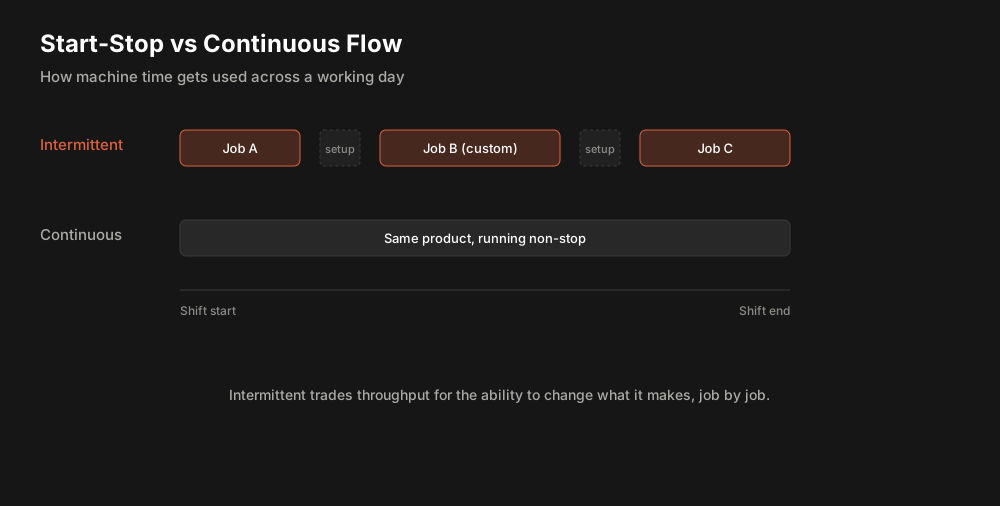
Intermittent production is a manufacturing approach where different products run through the same equipment in small batches or custom orders, with the line starting and stopping between jobs rather than running continuously. It suits high-variety, low-volume work where customization matters more than raw throughput.
Bakeries, custom machinery shops, and job-shop fabricators all run this way: the same machines produce different things depending on what order came in, with schedules that adjust order by order instead of following a fixed forecast.
What Is Intermittent Production?
Intermittent production runs in starts and stops rather than a continuous flow. The same general-purpose machinery gets reconfigured between jobs, and the production schedule adapts to whatever order came in rather than following a fixed forecast.
This makes it a natural fit for make-to-order and customization-heavy businesses that cannot justify dedicating a production line to a single product design.
It is closely related to, but not the same as, batch production. Batch production is one common way of running an intermittent operation; intermittent production is the broader category that also includes discrete manufacturing and job-shop work.
Intermittent Production vs Continuous Production
How the Two Approaches Compare
Lead time includes everything cycle time does not. Order processing, queue time before the machine is free, and shipping are all part of lead time but outside cycle time.
Takt time is a target, not a measurement. It tells you how fast you need to produce to meet demand, cycle time tells you how fast you actually are.
A cycle time win can hide a lead time problem. Producing a unit faster does not help if the order sat in a queue for three days before production even started.
Batch and unit cycle time get mixed up. The time to run a batch of 50 units is not the same as the cycle time per unit inside that batch.
Manual stopwatch tracking misses idle time between units. Without system timestamps, gaps between units quietly get folded into the cycle time number, inflating it.
Criteria
Intermittent Production
Continuous Production
Production Trigger
Customer orders
Demand forecast
Scale
Small batches, high product variety
Large scale, standardized output
Cost per Unit
Higher
Lower
The Main Types of Intermittent Production
Intermittent production covers a few distinct methods, each suited to a different level of customization:
Batch manufacturing. Groups of a single product move through production together, and the setup changes between batches for size, color, or design variations.
Discrete manufacturing. Distinct, interchangeable components are assembled into finished products, common where parts can be swapped or reconfigured across product variants.
Job shop manufacturing. Each job follows its own route through the shop floor based on a specific customer specification, with little repetition between orders.
Project-based manufacturing. A single large, complex order, custom machinery or a one-off industrial installation, occupies the shop floor for an extended period before moving to the next job.
Advantages and Disadvantages of Intermittent Production
The flexibility that makes intermittent production useful also creates its main costs:
Supports customization without dedicated tooling. The same machines produce different products across jobs, so you are not locked into one product design.
Comes with longer lead times. Changeovers between jobs and the lack of a fixed flow mean each order typically takes longer than the same volume would on a continuous line.
Keeps machine utilization efficient across product types. General-purpose equipment stays busy across multiple product lines instead of sitting idle waiting for one product’s demand.
Raises work-in-progress inventory. Partially completed jobs waiting for machine time or the next process step tie up more capital than a continuous flow typically does.
Limits scalability. Because output depends on available machine time split across many jobs, intermittent production does not scale to high volume the way a dedicated continuous line does.
Losing track of which custom job is where on the shop floor right now?
TranZact tracks every work order from material issue through dispatch, so each job’s status is visible in real time even as the shop floor switches between orders.
See every work order status in TranZact →
Where TranZact Fits for Intermittent Production
TranZact tracks every work order from material issue through every production stage, so switching between jobs on the same line does not mean losing visibility into where each one stands. Batch tracking keeps material consumption tied to the right job even as the shop floor changes tasks mid-shift.
That is not the same as a finite-capacity scheduling engine that automatically sequences jobs for you, and we would rather say that plainly than have you assume otherwise. For most Indian SME manufacturers running intermittent production, accurate work order and material visibility covers the operational gap well.
FAQ
What is an example of intermittent production?
A bakery making different cakes to order, a custom furniture workshop, or a job-shop machine tool manufacturer are all examples, the same equipment produces different outputs depending on which order is running.
What is the difference between intermittent and batch production?
Batch production is one method of running an intermittent operation, groups of one product move through together. Intermittent production is the broader category, which also includes discrete manufacturing and job-shop work where no two orders may be identical.
Is intermittent production the same as job-shop manufacturing?
Job-shop manufacturing is one type of intermittent production, focused on highly customized, often one-off orders. Intermittent production also includes batch and discrete manufacturing, which allow more repetition than a pure job shop.
What industries commonly use intermittent production?
Custom machinery, tool and die making, bakeries, garment customization, jewelry, and printing and packaging businesses that handle varied, order-specific work all typically run intermittent production.
Can a factory run both intermittent and continuous production?
Yes. Many manufacturers run a continuous line for a core standardized product alongside an intermittent setup for custom orders or lower-volume variants, using shared equipment where it makes sense.
Related Reading
Check out other blogs

Batch Production vs Mass Production
7 min read
Key differences between the two production strategies.
Read More

Cycle Time: Definition & Formula
6 min read
What cycle time measures and how to reduce it.
Read More

Production Planning System
8 min read
Meaning, objectives, and benefits of a formal production plan.
Read More

Born in India. Building for the world.
Built by IIT & IIM founders