← Back to All Blogs
Manufacturing Accounting · 7 min read · Updated Sep 2026
Product Costs vs Period Costs

TL;DR: Product costs are direct expenses of making goods, materials, labor, and factory overhead, that sit in inventory until sold. Period costs are time-bound operating expenses like admin, selling, and finance, expensed as soon as they are incurred. Manufacturers who blend the two get distorted margins and mispriced jobs.
This guide breaks down both cost types side by side, shows where Indian manufacturers most often misclassify them, and explains why getting the split right changes what a job actually costs to produce. For the full breakdown of period cost types alone, see our period costs guide.
Aspect
Product Cost
Period Cost
Definition
Cost incurred to manufacture or acquire goods for sale
Cost of running the business over a period of time
Traceability
Traceable to a specific unit, job or work order
Not traceable to any single product or job
When it is expensed
Capitalized as inventory, expensed as COGS only when the goods are sold
Expensed immediately in the accounting period incurred
Balance sheet treatment
Sits in inventory value until the sale happens
Never appears as inventory value
Typical examples
Raw materials, direct labor, factory power, machine depreciation
Office rent, admin salaries, marketing spend, sales commissions
Manufacturer impact
Drives the true per-unit cost and job margin
Affects overall profitability, not per-unit price
What Is a Product Cost?
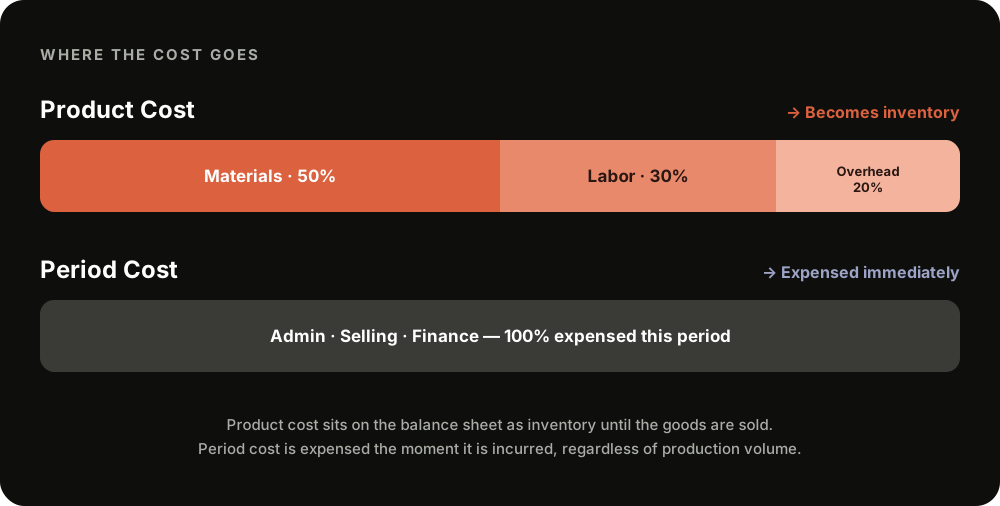
A product cost is any expense incurred to manufacture or acquire goods for sale: direct material, direct labor, and manufacturing overhead such as factory power, machine depreciation, and shop-floor supervision. Product costs are capitalized, they sit on the balance sheet as inventory and only hit the profit and loss statement as cost of goods sold once the product is sold.
What Is a Period Cost?
A period cost is any expense that keeps the business running but cannot be traced to a specific unit or job, such as office rent, admin salaries, marketing spend, and finance charges. Period costs are expensed in the accounting period they are incurred, regardless of how much the factory produced that period. For a deeper look at each type, see our period costs guide.
Types of Period Costs
Almost every period cost in a manufacturing business falls into one of these:
Administrative expenses. Office rent, admin salaries, accounting and legal fees, none tied to a specific production run.
Selling and marketing costs. Sales team salaries, advertising, trade show and travel expenses incurred to generate orders, not to fulfill them.
General overhead. Utilities, insurance and depreciation on non-production assets, distinct from factory overhead allocated to jobs.
Finance costs. Interest on loans and other financing charges, unrelated to any specific unit of production.
Where Manufacturers Mix Up Period and Product Costs
The same mistakes show up repeatedly when a business does not separate the two clearly:
Treating factory rent as a period cost. Factory rent is manufacturing overhead, a product cost allocated across jobs, not a period cost, even though it feels fixed like one.
Booking sales commissions into job cost. Sales commissions are a period cost, they should not be added into what a job actually costs to produce.
Ignoring period costs in pricing decisions entirely. A price built only on direct material and labor without covering period costs eventually erodes margin even on jobs that look profitable.
Averaging period costs into unit cost. Spreading admin and marketing spend evenly across units produced can distort per-unit cost when volume swings month to month.
No clean separation in the accounting system. When period and product costs sit in the same general ledger buckets, neither number can be trusted for a pricing or margin decision.
Does your margin number on a job include only what it cost to make it, or does it quietly include costs that have nothing to do with that job?
TranZact captures actual material and labor cost at the job and work order level, using your real BOM, so product cost stays separate from period expenses that belong on the P&L, not on a job card.
See Real Job Cost, Not a Blended Number →
How TranZact Helps Separate Product Cost From Period Cost
Job costs reflect actual material consumption and labor time tied to the work order, using your actual BOM, not a blended number that mixes in overhead or admin spend.
It does not replace your accountant’s judgment on how to allocate manufacturing overhead or classify a borderline cost. What it fixes is the direct product-cost half of the equation, so that judgment starts from a clean number.
FAQs
What is a period cost in simple terms?
An expense tied to time, not to producing a specific unit, like rent, admin salaries or marketing, that gets expensed in the accounting period it was incurred regardless of production volume.
Is factory rent a period cost or a product cost?
Product cost. Factory rent is manufacturing overhead, which is allocated across the units produced in that facility, even though it behaves like a fixed cost the way period costs do.
What is the difference between period cost and direct cost?
Direct cost is a specific type of product cost, material and labor traceable to one job. Period cost is the opposite category entirely, expenses that cannot be traced to any unit or job at all.
Do period costs appear in inventory value?
No. Period costs are expensed immediately in the period incurred. Only product costs, direct material, direct labor and manufacturing overhead, can sit in inventory value until the goods are sold.
Why does the period cost vs product cost split matter for pricing?
Because a price built only on product cost, without accounting for period costs somewhere in the margin, will look profitable on paper while still losing money once admin, selling and finance costs are counted.
Related Reading
Check out other blogs



Born in India. Building for the world.
Built by IIT & IIM founders