← Back to All Blogs
Manufacturing · 7 min read · Updated Sep 9, 2026
What Is Product Lifecycle Management (PLM)?

Product lifecycle management (PLM) is the practice of managing a product through every stage from design to discontinuation, so that inventory, production, and sales decisions match where the product actually is in its life, not where it was six months ago.
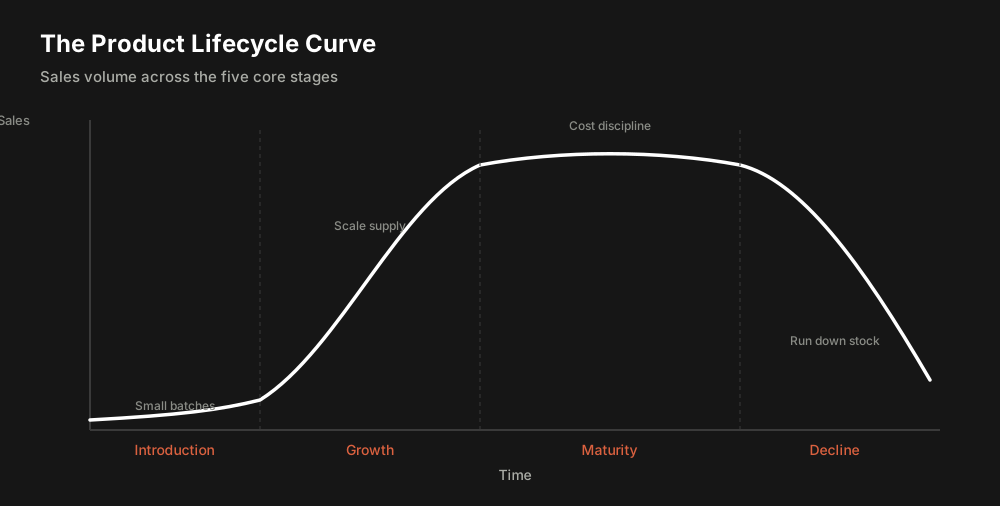
Every manufactured product moves through the same broad stages, design, introduction, growth, maturity, and decline, and each stage calls for a different inventory and production posture. Getting that timing wrong is what leaves factories holding dead stock or scrambling to keep up with a hit product.
What Is Product Lifecycle Management?
PLM covers a product’s full life: conceptualization, design and development, validation and testing, production, market introduction, growth, maturity, and eventual decline. Formal PLM ties design changes, bills of materials, and production data together so every department works off the same version of the product.
Without it, engineering, production, and sales end up working from different versions of the same product, an old BOM here, a superseded spec there, and the mismatches surface as scrap, rework, or stock that no longer matches what is actually being sold.
For most Indian SME manufacturers, PLM does not mean buying a dedicated PLM suite. It means treating each lifecycle stage as a deliberate decision point for purchasing, batch sizing, and stock levels, instead of running every product the same way regardless of where it stands.
How Inventory and Production Needs Shift by Stage
The Product Lifecycle Stage by Stage
Turns sales orders into a material and capacity plan automatically, instead of a manual re-check every time.
Pulls from live BOM and routing data, not a spreadsheet someone forgot to update.
Flags material shortages and overloaded work centers before the order is confirmed, not after.
Gives production, purchase, and sales the same view of what is actually scheduled.
Needs accurate BOM and stock data to work. Garbage in still means garbage out.
Stage
What’s Happening
Inventory and Production Focus
Design and Development
Product is being engineered and tested
Prototype-quantity purchasing, BOM still changing frequently
Introduction
Product launches, demand is unproven
Small batch runs, tight WIP tracking, fast feedback loops
Growth
Demand rises fast, sales outpace early forecasts
Scale up batch sizes, secure supplier capacity, build safety stock
Maturity
Demand stabilizes, competition increases
Standardize BOMs, optimize for cost, tighten inventory turns
Decline
Demand falls, product nears end of life
Run down existing stock, avoid new raw material commitments
Discontinuation
Product formally retired from the catalog
Liquidate remaining stock, redirect capacity to the next product
How to Manage Each Lifecycle Stage in Practice
A few practical moves make each transition less disruptive:
Order raw materials in small batches during introduction. Committing to large purchase quantities before demand is proven is the single biggest source of dead stock in a product launch.
Lock the BOM before scaling up in growth. Frequent design changes during a demand ramp create parallel inventories of old and new components that are hard to reconcile later.
Review slow movers every quarter once a product hits maturity. Maturity is where cost discipline pays off, tighter reorder points, fewer safety-stock buffers, and better supplier terms on stable volumes.
Set a hard stock cutoff date before declaring decline. Without one, purchasing keeps ordering out of habit long after demand has actually dropped.
Common PLM Mistakes in Manufacturing
Most lifecycle problems trace back to a handful of repeatable mistakes:
Treating every product like it is in the growth stage. Applying growth-stage batch sizes and safety stock to a mature or declining product ties up cash that could fund the next launch.
Letting BOM versions drift across departments. Design, purchase, and production working from different revisions of the same product is a common cause of costly rework.
Ignoring the maturity-to-decline signal. A drop in reorder frequency or a rise in returns usually shows up months before sales figures confirm the decline.
No formal handoff at discontinuation. Leftover raw materials and work-in-progress for a discontinued product sit in the warehouse indefinitely without an owner or a liquidation plan.
Managing PLM and inventory as separate conversations. Lifecycle stage should directly drive reorder points and batch sizes, not sit in a separate planning document nobody checks.
Still holding safety stock sized for a product that peaked two years ago?
TranZact gives you stock ageing and valuation history across every SKU, so you can see which products have quietly drifted into decline before the cash gets tied up in them.
See stock ageing by product in TranZact →
Where TranZact Fits for Product Lifecycle Management
TranZact is not a dedicated PLM suite, what it gives you is batch tracking and stock ageing history across every SKU, plus multi-level BOM and work order tracking that stays accurate as a product’s design and volume change stage to stage.
That is not the same as formal engineering-change control or a dedicated PLM workflow, and we would rather say that plainly than have you assume otherwise. For most Indian SME manufacturers, accurate BOM and stock visibility covers the operational half of PLM even without a dedicated PLM system.
FAQ
What are the stages of the product lifecycle?
The core stages are introduction, growth, maturity, and decline, often preceded by conceptualization, design and development, and validation and testing before the product ever reaches the market.
What is the difference between PLM and PDM?
PLM manages the full product lifecycle, including strategy, production, and eventual discontinuation. PDM (Product Data Management) is narrower: it manages design files, CAD data, and version control within the design and development stage.
Is PLM only useful for large enterprises?
No. Small manufacturers benefit from structured lifecycle thinking even without dedicated PLM software, mainly by tying purchase quantities and batch sizes to the stage a product is actually in.
How does PLM affect inventory decisions?
Each stage implies a different inventory posture: small, flexible batches during introduction, higher safety stock during growth, tighter reorder points at maturity, and a hard stock cutoff approaching decline.
When should a manufacturer formally discontinue a product?
When reorder frequency drops consistently, returns or complaints rise, and remaining demand no longer justifies the batch sizes needed to produce it economically.
Related Reading
Check out other blogs

Production Planning System
8 min read
Meaning, objectives, and benefits of a formal production plan.
Read More

Just-In-Time (JIT) Manufacturing
6 min read
Meaning, benefits, and risks of JIT production.
Read More

Inventory Control Models
8 min read
EOQ, ABC Analysis, Min-Max, and other models compared.
Read More

Born in India. Building for the world.
Built by IIT & IIM founders