← Back to All Blogs
Cost Management · 6 min read · Updated Sep 8, 2026
Production Costs: Direct vs Indirect, and How to Calculate Them

Production costs are every direct and indirect expense a factory incurs to turn raw material into a finished product: raw material, direct labour, and manufacturing overhead. Getting this number right matters because it sets the minimum price you can charge without losing money on every unit you sell.
This guide breaks down direct versus indirect costs, walks through the calculation step by step, and covers why most Indian SME manufacturers underprice products by tracking direct costs closely while guessing at overhead.
What Are Production Costs?
Production costs are the total expense of manufacturing a product: raw materials, the labour directly working on it, and the overhead, power, rent, depreciation, maintenance, that keeps the factory running whether or not that specific unit is being made.
Production cost is not the same as cost of goods sold. Production cost is what it costs to make a unit, cost of goods sold is what it cost to make the units you actually sold in a given period, adjusted for opening and closing inventory.
Every pricing decision, quote, and margin target depends on this number being accurate. Underestimate it, usually by underestimating overhead, and you can be selling at a loss without realising it.
Direct Costs vs Indirect Costs
Direct costs are traceable to one unit: raw material and the labour hours spent making that specific product.
Indirect costs are shared across everything you make: rent, power, machine depreciation and supervisor salaries do not belong to any one unit.
Direct costs scale with volume: make double the units, and direct material and labour roughly double too.
Indirect costs mostly do not scale with volume: your rent is the same whether you make 100 units or 1,000.
Most costing errors happen on the indirect side: direct material is easy to track from a purchase order, overhead allocation is where guesswork creeps in.
See the Full Comparison Below
Aspect
Direct Costs
Indirect Costs
What it includes
Raw material, direct labour, packaging tied to the unit
Rent, power, depreciation, supervisor salaries, maintenance
Traceable to a specific unit
Yes, directly
No, allocated across all units
Behaviour as volume changes
Scales roughly with output
Stays largely fixed regardless of output
How it is usually tracked
Purchase orders and labour hours logged per job
Estimated and allocated using a cost driver, like machine hours
Risk of under-costing
Low, numbers come from actual purchase and payroll data
High, a wrong allocation rate understates every product’s true cost
Effect on pricing
Sets the floor price per unit
Determines whether that floor price actually covers the business
How to Calculate Production Cost
The calculation has four steps, and the fourth is where most manual spreadsheets fall apart:
Add up direct material cost. Total raw material and components actually consumed for the batch, priced at actual purchase cost, not an old standard rate.
Add direct labour cost. Hours worked on that job multiplied by the labour rate, tracked per work order, not averaged across the whole factory.
Allocate manufacturing overhead. Divide total indirect costs for the period by a sensible driver, machine hours or labour hours, and apply that rate to the job.
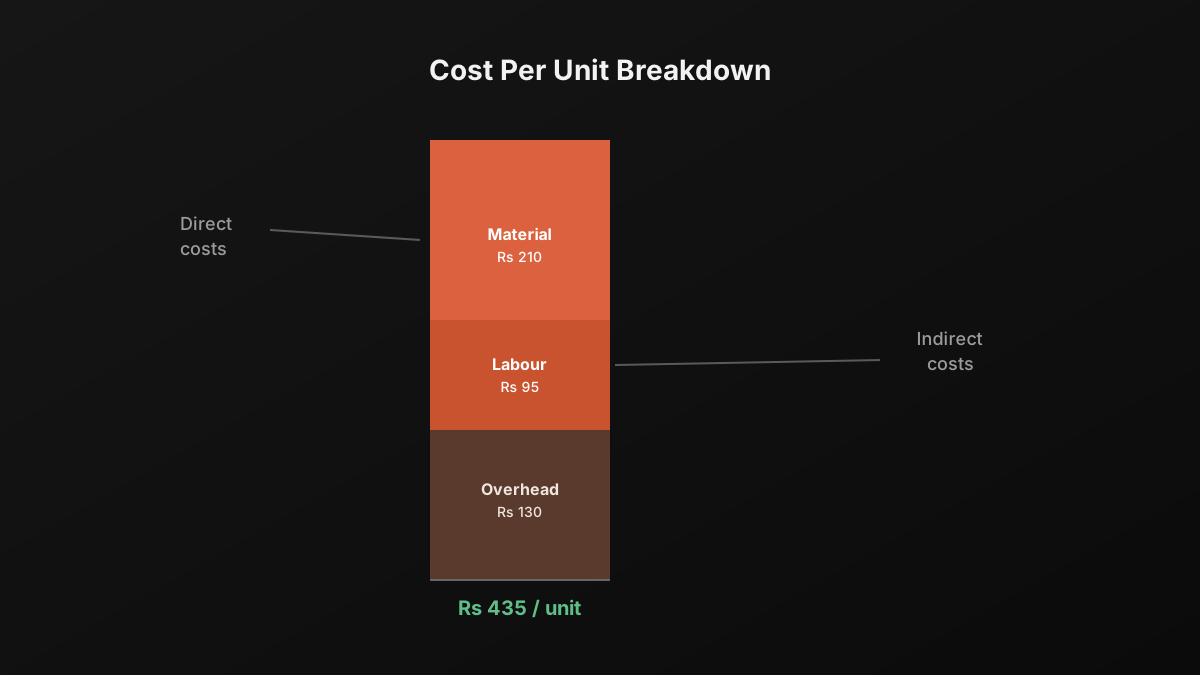
Sum and divide by units produced. Direct material plus direct labour plus allocated overhead, divided by output, gives you cost per unit.
Where Production Costing Breaks Down in Practice
Costing goes wrong in a handful of predictable ways, especially on manual spreadsheets:
Overhead allocated by guesswork. A flat percentage applied to every product regardless of how much machine time or labour it actually consumes distorts the true cost of every SKU.
Material cost frozen at an old rate. Using last quarter’s purchase price instead of the actual landed cost understates material cost the moment prices move.
Labour hours estimated, not logged. Without real time tracking per job, labour cost becomes an average that overstates cheap jobs and understates expensive ones.
Scrap and rework left out entirely. Material lost to defects still cost money, leaving it out of the calculation quietly inflates your margin on paper.
No visibility until month-end. If cost per job is only known after the accounting close, you cannot catch an underpriced quote before it ships.
Not sure your quoted price actually covers your real production cost?
TranZact tracks actual material and labour cost at the job and work order level, so you see the real cost per unit before you commit to a price, not after the month closes.
See your real production costs by job →
How TranZact Helps With Production Costing
TranZact tracks actual material consumption and labour hours against every work order, instead of relying on a standard cost that goes stale the moment prices move. It ties that to real-time component stock, so material cost reflects what was actually issued, not an estimate. Our production cost analysis guide goes deeper into building a full costing model.
TranZact does not replace your accountant’s overhead allocation policy, that judgment call on which cost driver to use still belongs to you. What it gives you is accurate, real-time direct cost data so the allocation is applied to numbers you can actually trust.
FAQs
What is included in production cost?
Direct material, direct labour, and manufacturing overhead: rent, power, depreciation and other costs that keep the factory running regardless of which specific product is being made.
What is the difference between production cost and cost of goods sold?
Production cost is what it costs to manufacture a unit. Cost of goods sold is the cost of the units actually sold in a period, adjusted for opening and closing inventory.
How do you allocate overhead to a specific product?
Pick a cost driver that reflects how the product actually consumes overhead, commonly machine hours or direct labour hours, then divide total overhead for the period by total driver units to get a rate per hour.
Why do manufacturers underprice their products?
Usually because overhead is estimated with a flat guess instead of allocated by actual usage, or because material cost is tracked at an old rate instead of the current purchase price.
How often should production cost be recalculated?
Direct costs should be tracked per job in real time. Overhead allocation rates are usually reviewed monthly or quarterly, more often if raw material prices are volatile.
Related Reading
Check out other blogs



Born in India. Building for the world.
Built by IIT & IIM founders