← Back to All Blogs
Inventory Management · 6 min read · Updated Aug 25, 2026
Semi-Finished Goods Explained

TL;DR: Semi-finished goods are materials that have completed some but not all production stages, past raw material but short of a finished, sellable product. They still carry the material and labor cost already invested, so undercounting them understates true inventory value and hides cash tied up mid-process.
This guide covers what qualifies as a semi-finished good, how it is different from work-in-progress and finished goods, and why manufacturers who track it separately get a truer picture of where their inventory value actually sits.
What Are Semi-Finished Goods?
Semi-finished goods are items that have completed one or more stages of production but still need further processing before they become a sellable finished product.
They can sit in two states, consumed immediately into the next production stage, or stocked deliberately as an intermediate buffer, for example a subcomponent made in bulk and drawn down as needed across multiple finished SKUs.
The distinction matters for costing. A semi-finished good already carries the material and labor cost of every stage completed so far, so undercounting it understates how much value is actually sitting in the factory at any moment.
Semi-Finished Goods vs Finished Goods
Processing stage: semi-finished goods have completed some but not all production stages; finished goods are fully processed and dispatch-ready.
Cost carried: semi-finished goods carry partial cumulative cost; finished goods carry full cumulative material, labor and overhead cost.
Saleability: semi-finished goods are typically not sold directly, except in industries that sell components as-is; finished goods are ready for the customer.
Storage purpose: semi-finished goods are often stocked deliberately as a shared buffer across multiple end products; finished goods are stocked to meet dispatch commitments.
Manufacturer relevance: undercounting semi-finished stock is the more common error, since it is easy to track raw material and finished goods but skip the stage in between.
Semi-Finished Goods vs Work-in-Progress vs Finished Goods
How Semi-Finished Goods Differ From Related Terms
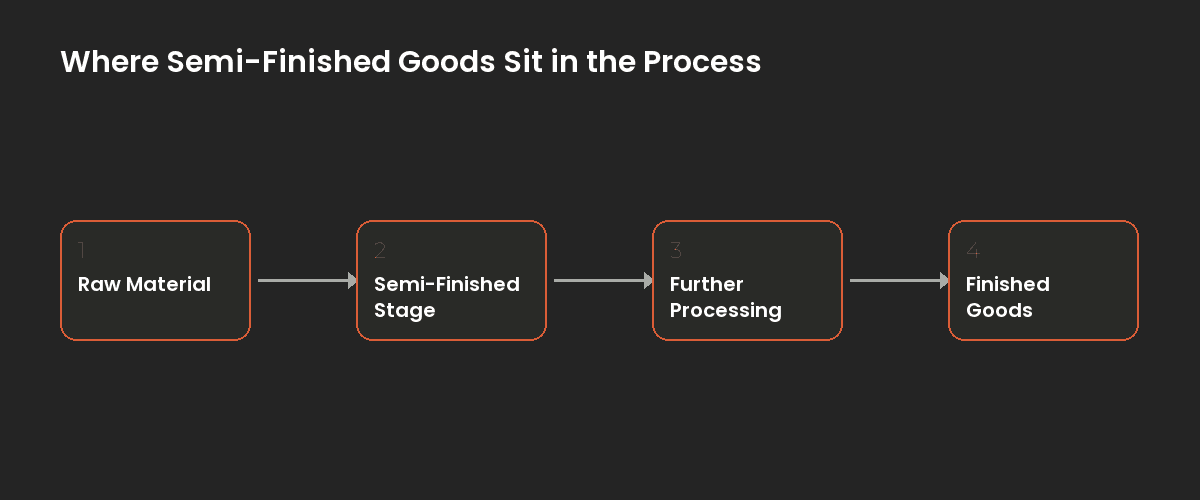
The three terms get used loosely, but they describe different points in the same process:
Raw material. Unprocessed input, purchased and not yet touched by production, no labor or processing cost added yet.
Work-in-progress (WIP). Anything currently mid-process on the shop floor at a given moment, a broader, more instantaneous snapshot than semi-finished goods.
Semi-finished goods. Completed one or more production stages, stocked as inventory rather than sitting mid-process on a machine right now.
Finished goods. Fully processed, packaged and ready for dispatch or sale, carrying the full cumulative cost of every stage.
Why Tracking Semi-Finished Goods Separately Matters
Lumping semi-finished goods in with raw material or finished goods creates the same five problems repeatedly:
Understated inventory value. Material and labor already invested in semi-finished stock does not show up anywhere, understating true inventory on the books.
Wrong reorder decisions. Purchasing over-orders raw material without accounting for semi-finished stock that could cover the next batch.
No visibility into bottleneck stages. Without tracking semi-finished stock by stage, nobody can see which production step is actually piling up inventory.
Costing errors on the next stage. A finished goods cost calculation that ignores the labor already sunk into semi-finished inputs understates true job cost.
Audit and valuation gaps. Year-end stock valuation misses a real inventory category if semi-finished stock is not tracked as its own line.
Do you know how much value is sitting in semi-finished stock right now, or only what is in raw material and finished goods?
TranZact tracks stock at every production stage, raw material, semi-finished and finished goods, warehouse-wise and in real time, so nothing sitting mid-process goes uncounted.
Track Value at Every Production Stage →
How TranZact Tracks Semi-Finished Goods
TranZact’s work orders track material at every stage it moves through, with warehouse-wise and real-time stock tracking and batch-level detail where a semi-finished item is drawn down across multiple finished SKUs.
It does not replace a cost accountant’s judgment on how overhead gets allocated across stages. What it fixes is the visibility gap, knowing what semi-finished stock physically exists before that costing question even comes up.
FAQs
What is an example of a semi-finished good?
A machined component that still needs assembly, plating or painting before it becomes a finished product, or a subassembly made in bulk and drawn down into several different finished SKUs.
Is semi-finished goods the same as work-in-progress?
They overlap but are not identical. WIP is a snapshot of everything currently mid-process on the shop floor at a given moment. Semi-finished goods specifically refers to completed intermediate stock, whether or not it is moving right now.
How are semi-finished goods valued on the balance sheet?
At the cumulative cost of every production stage completed so far, raw material plus the direct labor and allocated overhead for each stage the item has already gone through.
Why do manufacturers stock semi-finished goods instead of processing straight through?
Usually to buffer a shared subcomponent across multiple end products, or because a batch process runs more efficiently at a larger size than what any single finished order needs.
Does every manufacturer need to track semi-finished goods separately?
It matters most for multi-stage production with shared subcomponents. A single-stage assembly operation with no intermediate stocking point may not need a separate semi-finished category at all.
Related Reading
Check out other blogs



Born in India. Building for the world.
Built by IIT & IIM founders